3 KYU - GREEN BELT / BROWN STRIPE
Sankyu

“Although it is important to study and train for skill in techniques, for the man who wishes to truly accomplish the way of Budo, it is more important to make his whole life in training and therefore not aiming for skill and strength alone and but also for spiritual attainment.”

Here you will find all the information you need to prepare you for your grading. This information includes your theory and your practical test. I hope this information helps you in giving you a better understanding about Kyokushin Karate and also gives you a better understanding of your requirements and at the same time helps you to study and prepare for it. 

MEANING OF THE BELTS

Below you will find a possible interpretation of the symbolism of the belt colors. I hope this will give a further understanding the sense in which the Obi (belts) colors mean. Belts colors are not only to reflect growth in technique, but also in character.

The Green Belt (Emotion and Sensibility)
At this level the students are beginning to have a more deep control of the techniques and Basic Katas as well starting to learn the more complexes techniques and Katas. The training at this level is harder and requires more time and commitments. Here the students should achieve a better control of his mind and body, also more endurance and a more deep understanding and meaning of the techniques. The sparring is also more exigent.
The students can not pass this level if he/she does not demonstrate a clear aptitude of leadership, the students must be willing to accept the responsibility that it imply when they are in the position of leading others. The students at this level must have a deep understanding of the Dojo Etiquette and apply those concepts in class, also must be able to communicate with all the students and also must be willing to help the lower belts to understand proper Dojo Etiquette in the Dojo, this mean he/she must be the example by following those rules all the times inside the Dojo.

CLICK HERE FOR A MORE DEEP MEANING OF THE GREEN BELT

horizontal rule


WHAT YOU SHOULD KNOW FOR YOUR
KYOKUSHIN THEORY TEST
3 KYU - GREEN BELT / BROWN BELT  

Below  are some vocabulary you should be able to know  in order to do your grading.

vocabulary

Name

Meaning

Sankyu
Midori-Obi
Cha-Obi
Shuto
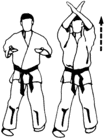
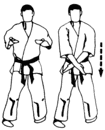
Shuto Juji Uke
Hikkake
Uchi
Soto
Kakato
Oroshi
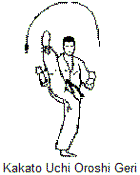
Kakato Uchi Oroshi Geri
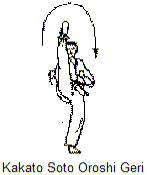
Kakato Soto Oroshi Geri
Mae Kakato Geri
Chusuku
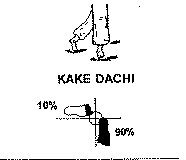
Kake
Kake Dachi
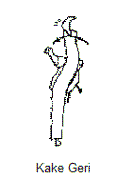
Kake Geri (Kakato & Chusoku)   

Kawashi
Kuzushi
Kosaho
Mae
Morote
Ashi (1)
Ashi (2)
Ryusui
Tsugi-ashi
Sashi-te
Suri-ashi
Mudansha
Yudansha
Haisoku
Heisoku
Enkei - Ippon
Third Kyu
Green Belt
Brown Belt
Knife hand
Knifehand X block
Hook and pull
Inside
Outside
Heel
Descending
Inside Axe Kick
Outside Axe Kick
Front kick with the heel
Ball of the foot
Hook
Hooked Stance
Hook Kick (with heel & Ball of the foot)

Dodge and Parry
The unbalancing of the opponent
Simultaneous defense/counter attack
Front, Forward
Double, Reinforced
Foot or Leg (1)
One Leg or Single Leg (2)
Dodge tactic

Shuffle step
Extending hand .
Blocking and moving forward into opponent and attacks
sliding step
The one who had not yet attained Dan ranking/Kyu grade student
Dan Rank (Black Belt Holder)
Instep (above or top part of the foot)
Feet together (Closed)
Circle and Point

Heisoku: Is Japanese for "feet together" (as in "Heisoku-Dachi," Feet-together Stance). Sometimes mistaken for "Haisoku". Literally, a combination of the Japanese character "hei" ("shut" or closed) and "soku" (foot)

Sashi-te: Extending hand . It is a defensive move where one simultaneously blocks, enters into the opponent's range, and attacks.

YOU SHOULD KNOW AND HAVE A DETAIL UNDERSTANDING OF:

I) Kuzuchi: Kuzuchi is the way of unbalancing the opponent. It could be by blocking and trapping or holding. Below you will find some ways Kuzuchi can be achieved:
1.- Hands: Pushing & Pulling
2.- Feet: For example, blocking the opponent from stepping forward
3.- Body: Bending, pivoting, twisting or bumping the opponent to unbalance
4.- Voice or Sound:
Distracting, or mentally unbalancing the opponent.

II) Dojo Kun

III) Pinan Kata


YOU SHOULD BE ABLE TO EXPLAIN:

- The meaning of Green Belt in more details
 

horizontal rule

REQUIREMENT FOR THE PRACTICAL TEST
DOJO ENTHEOS

Below you will find all what you need to know for your grading. It was designed to supply the students with information about theirs requirements for theirs grades. If you have any question regarding the requirements consult your teacher. The grading requirements in our school contain the following:

3rd KYU - ( GREEN BELT/BROWN STRIPE )

Time in Classes : 26 Months (2 years & 2 months / Three classes a week - 90 minutes class )
                                    6 Months since yours Green Belt Testing
Theory :
bullet

Students must know the previous syllabuses.

bullet

Essay: The Student should present and essay explaining the theory or concept of the "Point and Circle" in Kyokushin Karate.  This essay must be complete and presented to the teacher the same day you give the written test.

bullet

Meaning of : Green Belt

bullet

Meaning of :
- Kyokushin Calligraphy
- Kanku Symbol

Physical Requirement:

bullet

50 Hands Push Ups

bullet

30 Knuckle Push Ups

bullet

10 Finger Tip Push ups

bullet

40 Deep Knee Bends With Front Kick

bullet

1 Min. Rabbit hop

bullet

2 Min. Jump Rope (3 rounds)

bullet

1Serie of Abdominal   

1) Stances (Tachikata / Dachi):
bullet

Kake Dachi (hooked stance)

2) Uke: (Blocks)
bullet

Shuto Juji Uke Jodan (High Knifehand X block)

bullet

Shuto Juji Uke Gedan (Low Knifehand X block)

3) Kicks: (Keri)
bullet

Mae Kakato Geri Chudan (front kick with the heel instead of the ball of the foot)

bullet

Mae Kakato Geri Jodan (front kick with the heel instead of the ball of the foot)

bullet

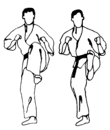
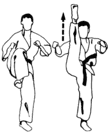
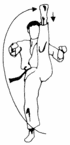
Kakato Uchi Oroshi Geri (Inside Descending heel kick / Axe kick )

bullet

Kakato Soto Oroshi Geri (Outside Descending heel kick / Axe kick )

bullet

Kake Geri (hooked kick)

4) Forms: (Katas)
 

Pinan Sono San: Peaceful Mind; Peaceful Safety   Movie, 1 Camera   Movie, 3 Camera
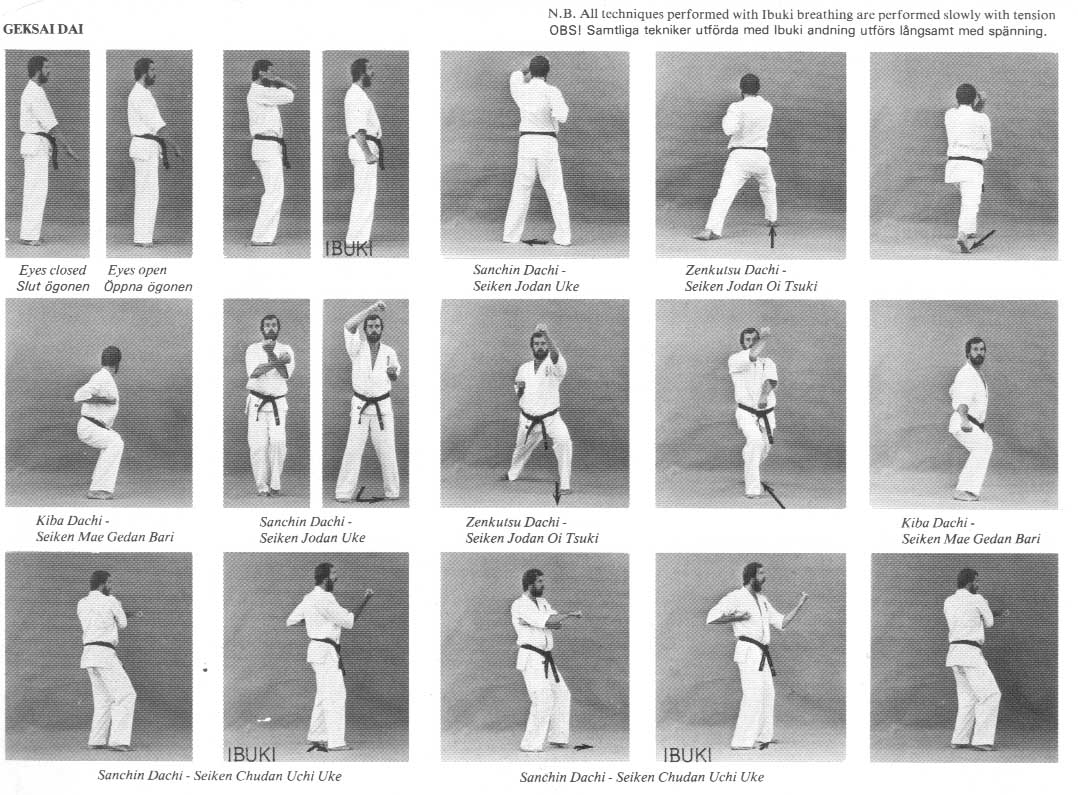
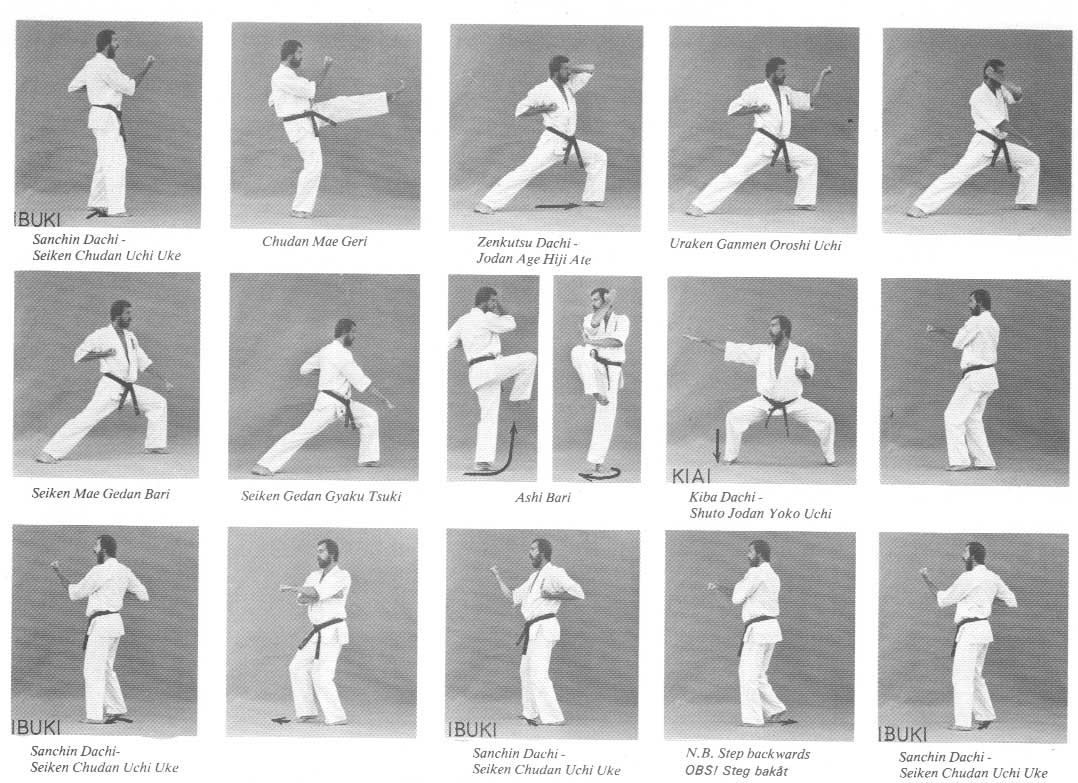
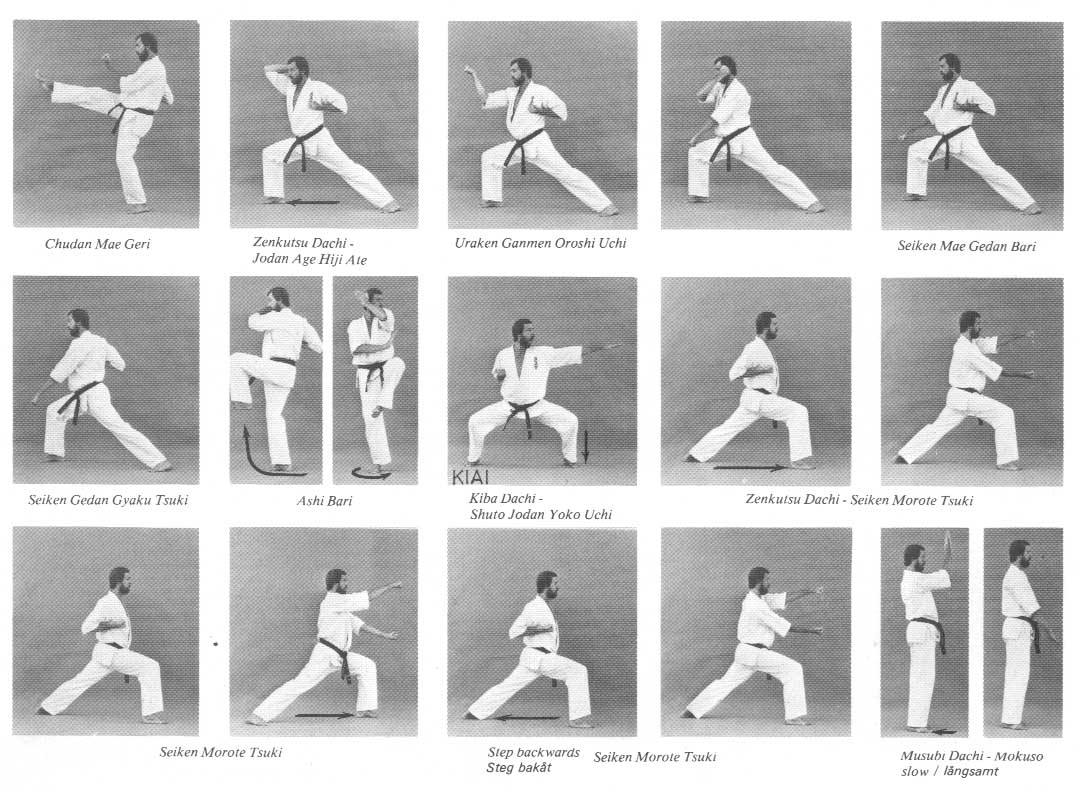
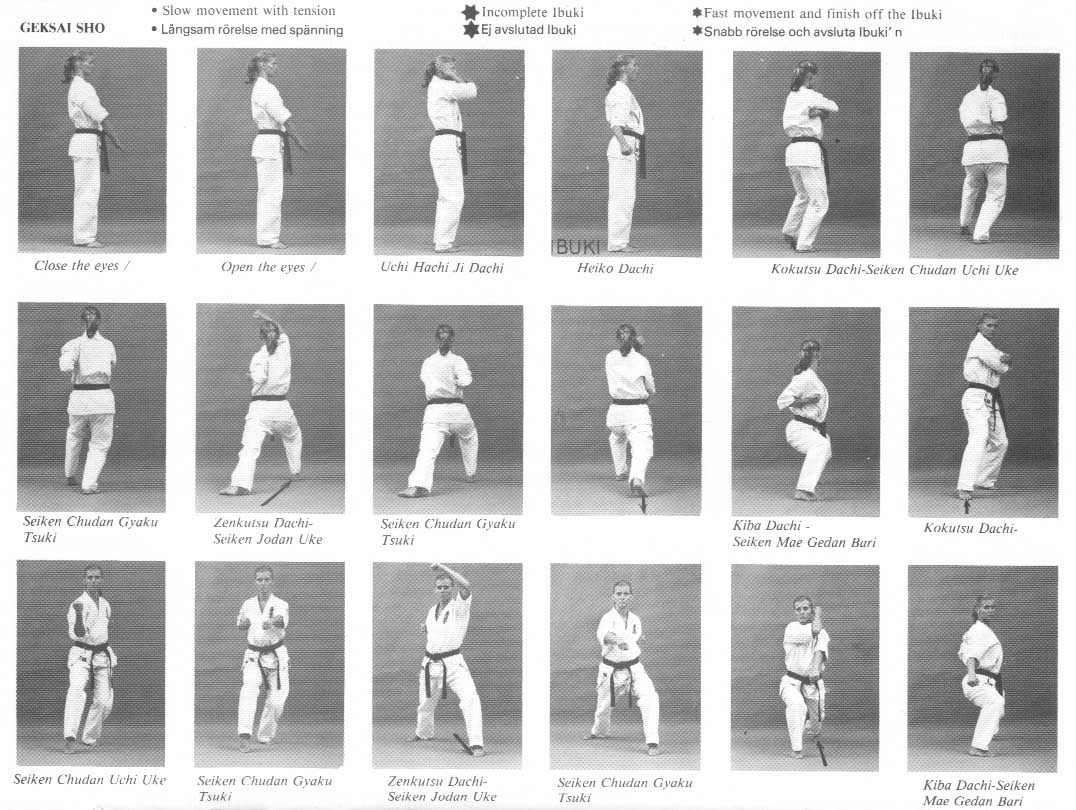
Gekisai Dai: Gekisai means conquer and occupy or destroy, demolish. page1      page2     page3 
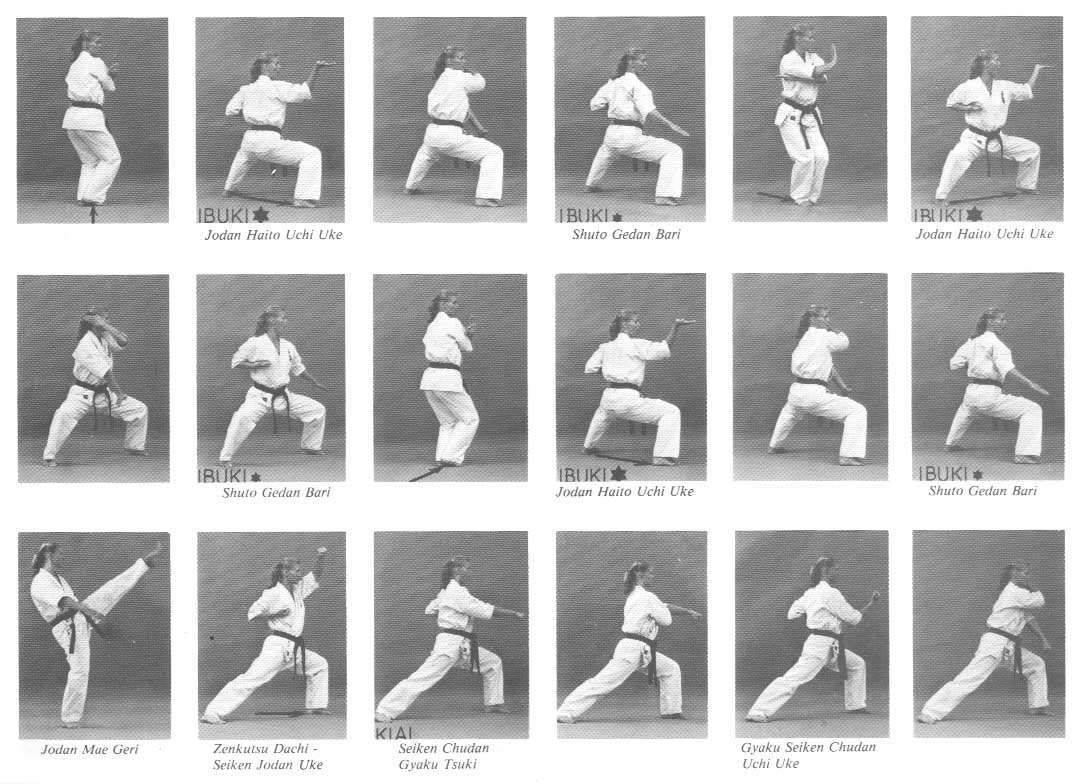
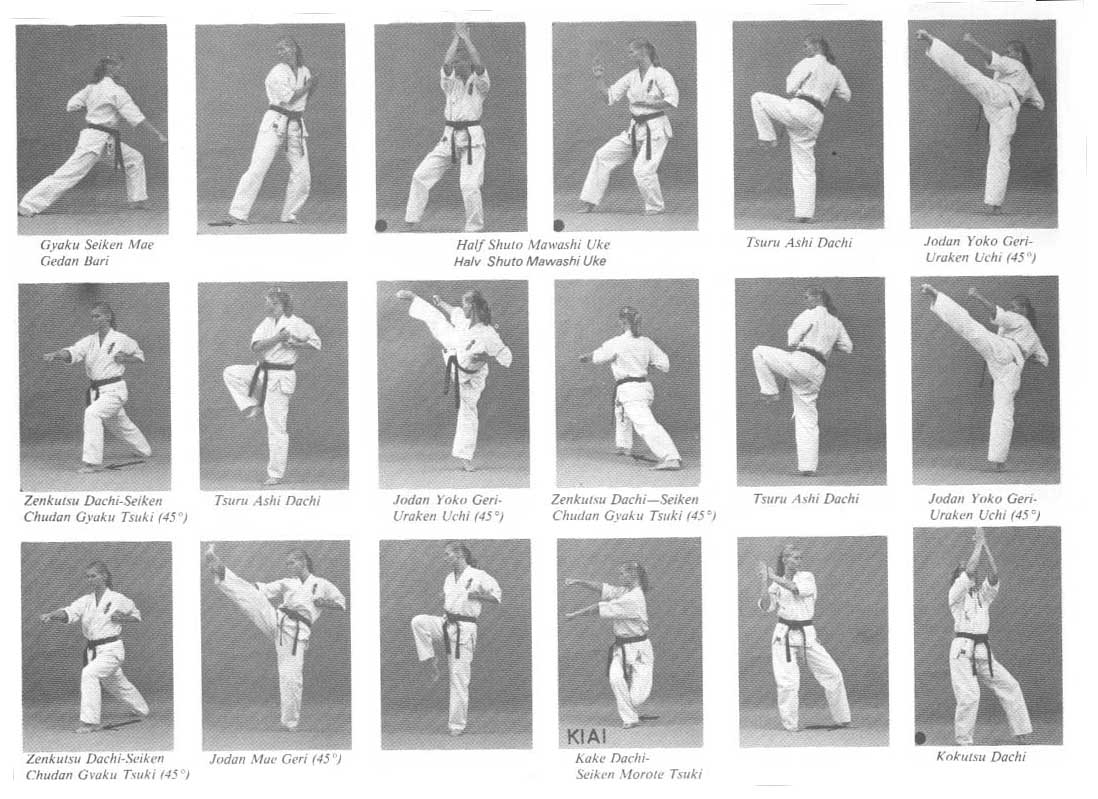
Gekisai Sho: Gekisai means conquer and occupy or destroy, demolish.

page1      page2      page3    page4


 Combinations - ( Renraku ) :
bullet

Combinations as required ( hands and legs techniques, striking and blocking )
 

Self Defense - ( Goshin Jitsu ) :

bullet

Ippon Kumite:
Using basic techniques in Ippon Kumite with a good understanding of Kawashi, Kuzushi, Ryushi, Sashi-te. Suri-ashi, Hikkake.

bullet

Use of Tai-Sabaki

bullet

Releasing techniques using the concept of sashi-te


Sparring - ( Kumite ) :

bullet

Six Sparring of 2 minutes

The students should be able to execute the techniques using any of the stances. Also the students would be tested on any techniques from previous belt.

horizontal rule

KYOKUSHIN KATAS
 

Literally Kata means, Form or Shape. Kata are pre-arranged forms of demonstrating methods of attack, defense and counter-attack. It use Blocks, Punches or Kicks directed from one or more stances, it involve movement to the sides, forward or backward. Sosai Masutatsu Oyama wrote on one of his book " We should perform these exercises (Kata) so exactly that they become a part of our very lives because as fundamentals of karate they my be compared to the letters of an alphabet in that, just as letters are the building blocks of words and sentences, so these fundamentals are the building blocks from which karate is built ". He also wrote " think of karate as a language : The basic techniques can be  thought of as the letters of an alphabet; the Kata (forms) will be the equivalent of words and sentences; the Kumite ( sparring ) will be analogous to conversations ".
    Sosai Masutatsu Oyama believed that is better to perfect one Kata than to half-master many. He wrote that if a person practices any given Kata over 3000 times, any questions he   might have have about it will be resolved, and a proper understanding of the exercise will naturally emerge.
    All Kata has a name, given by the master who developed the Kata. These names are clues to the deepest meaning of the Katas, unfortunately  most students ignore them as just labels. below I will try to describe the meaning of the different Katas with the hope that it will help you to understand better your forms.

Pinan Sono SAN - OMOTE:

The word 'Pinan' usually had been translated as 'peaceful mind', but a more correct translation should be "Safe from Harm"  (same characters can be read as "Safe from Harm" in Chinese). The name is taken to mean that once these five forms and their applications have been mastered the karateka can be confident in their ability to defend themselves in most situations. The word 'Pinan' is made up two ideograms. The original Okinawan pronunciation of the first ideogram is 'pin', whereas the Japanese pronounce it 'hei.' Generally Wado-Ryu & Shito-Ryu favour the Okinawan pronunciation of 'Pinan'. Shotokan stylists favour the Japanese pronunciation of 'Heian.' The reason for this is that Sensei Gichin Funakoshi gave all the katas practiced within Shotokan Japanese names. He did this so that the Japanese people would find the names easier to use, to further distance the art from any of its Chinese origins and to acknowledge the development of karate by the Okinawans & Japanese. Sensei Gichin Funakoshi also swapped the 'Nidan' (2nd level) & 'Shodan' (1st level) suffixes so that the names reflected the order in which the katas are most commonly taught. This means that Shotokan's 'Heian Shodan' is called "Pinan Nidan" in the remaining styles and vice-versa.

The Pinan were originally created by Sensei Anko Itosu in 1905. Later on were simplified by Sensei Gichin Funakoshi founder of the Karate style named, Shotokan were the Pinan Katas are know as Heian.  Sosai Masutatsu Oyama later on adopted and incorporated those Katas in Kyokushin Karate with a few modifications to adapt those Katas to the Kyokushin stances given emphasis to the force 

The 5 Pinan Katas has influence from the North part of China - Shuri-te


Pinian Sono San Peaceful Mind; Peaceful Safety (3)   Movie, 1 Camera   Movie, 3 Camera

Gekisai Dai - Gekisai Sho:

Gekisai means conquer and occupy or destroy, demolish. They were created by Chojun Miyagi (Founder of the Goju Ryu style) in 1940.
(This Kata has influence from the South part of China)


horizontal rule


STANCES AND WEIGHT DISTRIBUTIONS (DACHI)


BLOCKS (UKE)


FEET STRIKES (KERI)


horizontal rule

For more information contact your teacher, sensei Angel Carrasco at: angel@kyokushincanada.com


GO TO THE MAIN PAGE OF WINNIPEG KYOKUSHIN KARATE - DOJO ENTHEOS