 |
 |
 |

|
|
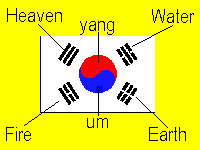
TaeGukKi Korean National FlagThe Korean national flag is called TaeGukKi or TaeKukKi. The meaning of Korean National Flag is very philosophical. The origin comes from the old oriental philosophy called the theory of Eum-Yang, in chinese pronounciation Yin-Yang. Yin means negative, dark, and cold; Yang means positive, bright, and hot. The idea of Yin-Yang is supposed to be originated from the old Korean philosophy of SamSin meaning three gods.A very old book called JooYuk or IChing in chinese, which was written by (a) chinese several thousands years ago, claims all (physical or virtual) objects and events in the world can be expressed by the movement of yin and yang. For example, minus(-) is yin while plus(+) is yang; the moon is yin while the sun is yang; the earth is yin and the heaven is yang; a woman is yin and a man is yang; the night is yin and the day is yang; the winter is yin and the summer is yang, etc. Yin and yang are relative, which means A can be yin with respect to B while A can also be yang with respect to C. For instance, the spring is yin w.r.t. the summer and it is at the same time yang w.r.t. the winter. Yin and yang are opposite and struggle each other while they cooperate in harmony. The harmonious state of the movement of yin and yang is called TaeGuk, Taichi in chinese, which is also the name of the Korean national flag, i.e. TaeGuk-Ki or TaeKuk-Ki. Ki means a flag. (See the similarity between the concept of Yin-Yang-Taichi and the dialetics of thesis-antithesis-syntheis.) The upper half circle, red, of TaeGuk means yang and the lower half circle, blue, means yin. They stand for the state of harmony of yin and yang. The symbols, called Kwe, in the four corners, mean the principle of movement and harmony. Basically, each Kwe cosists of three bars that can be either broken or unbroken bars. A broken bar stands for yin while an unbroken bar stands for yang. For example, the upper left Kwe, called Kun or Keon, is composed of three solid unbroken bars. And the lower left Kwe, called Yi, is composed of two unbroken bars and one borken bar in between. Since one bar can be either broken or unborken, i.e. same concept as bit as in the binary computer world, three bars can express 2**3 = 8 combinations. If you use four bars you can express 2**4=64 combinations; 10 bars, 2**10=1024, etc. Therefore the more bars you use the more different situation you can express with Kwe. Among so many states of Kwe, i.e. principle of movement of objects and events, four basic Kwe are used in the Korean National Flag. Those are Kun meaning heaven, Yi meaning fire, Kam meaning water, and Kon meaning earth. Each of them symbolizes a different state of movement. ___ ___ _ _ _ _
Kun ___ Yi _ _ Kam ___ Kon _ _
___ ___ _ _ _ _
To conclude, the symbols, Yin, Yang, Kun, Yi, Kam, and Kon, express the principle of the movement of all objects in the universe and the movement of the universe itself. It also stands for peace and harmony.
Taegukki (Korean National Flag) Components "Taeguk" in
Taegukki means xxxxxxxxxxxxx. "Ki" is a flag. The American flag (Stars
and Stripes) is called "SungjoKi" in Korean, "Sung" being
stars and "jo" being stripes.
Cardinal numbers
| ||||||||||||||||||||||||||||||||||||||||||||||||||||||||||||||||||||||||||||||||||||||||||||||